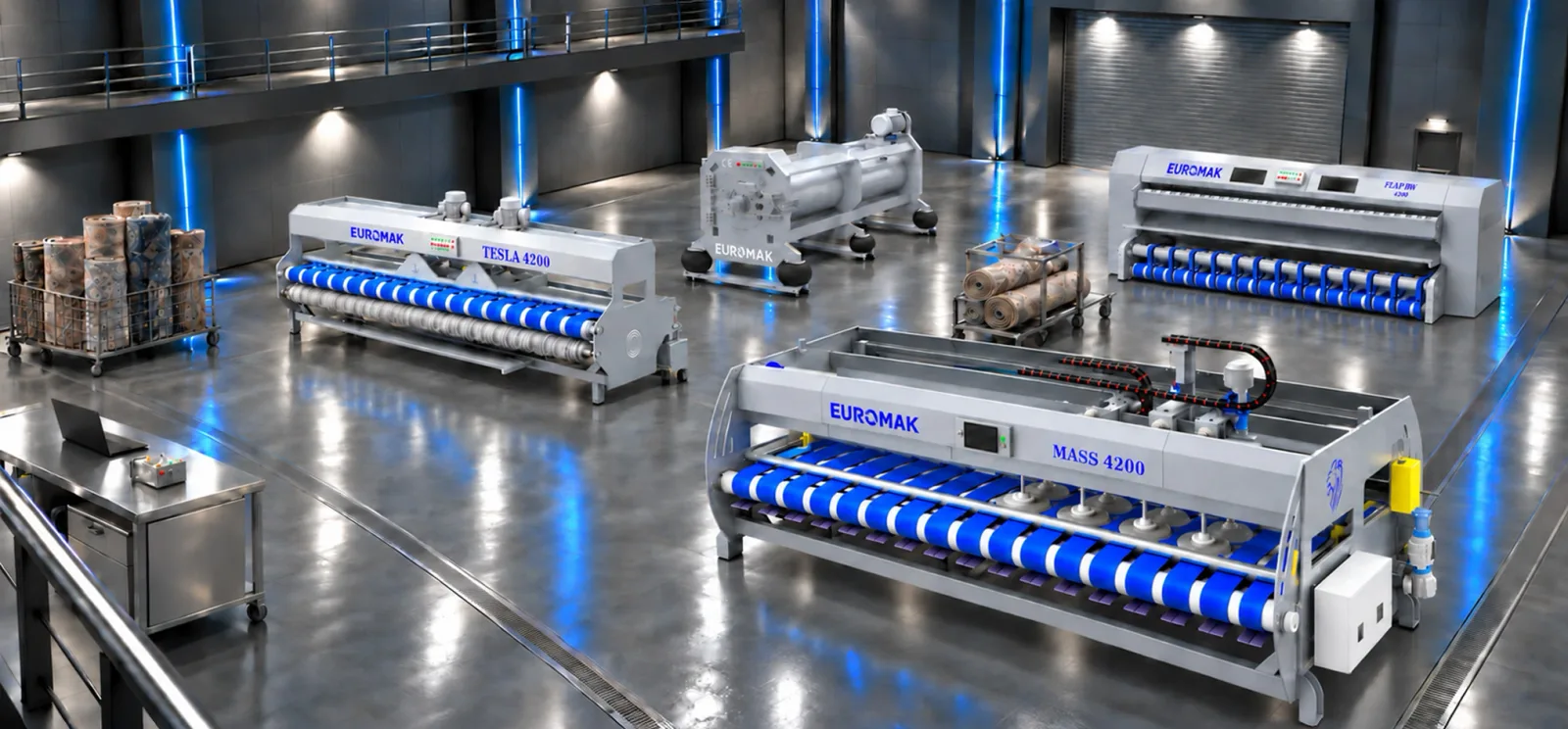
Setting up a carpet washing plant professionally involves far more than simply buying a carpet washing machine. For an efficient and sustainable business, plant capacity, the machine lineup, working space, staffing needs, drying capacity and service infrastructure must all be planned together.
Choosing the wrong capacity can inflate the investment cost unnecessarily, while an incomplete or unbalanced machine lineup can slow down production even when high-capacity machines are in place. That is why, before any investment decision, the entire plant should be evaluated as a single production system.
Determine your daily carpet washing capacity
The first question to answer before selecting any machine is how many square metres of carpet the plant needs to process per day. Instead of planning capacity around the busiest season alone, it is far more reliable to build separate scenarios for the normal period, the peak season and your growth target over the next two to three years.
Rather than over-investing for the single busiest day, base your plan on a sustainable average capacity and an acceptable delivery time for your customers. Real production capacity is not set by the carpet washing machine alone; it is determined by the full chain of dusting, extraction, drying, quality control and packaging processes.
Analyse your service area and customer potential
In professional carpet washing plants, capacity requirements can vary significantly depending on the area served. The local population, the number of competing businesses, average carpet sizes, seasonal demand, the target delivery time and the daily collection capacity of the service vehicles should all be evaluated together.
As the service area grows, it is not only washing capacity that expands; the vehicle fleet, the dirty-carpet intake area, storage, packaging and dispatch organisation grow with it. That is why looking only at the machines' technical specifications is not enough when calculating plant capacity.
Build a one-way plant flow
In a well-planned carpet washing plant, product movement should be as close to one-way as possible. Create an irreversible production flow from dirty intake to clean packaging: registration, dusting and dust removal, washing, extraction, drying, final sweeping, quality control, packaging and dispatch.
Separating dirty and clean areas reduces the hygiene risk. Preventing unnecessary handling and backtracking lowers both the workload on staff and the risk of operational damage to the carpets.
When preparing the plant layout, account not only for the footprint of the machines but also for the working corridors between them, product holding areas and service access.
Build a machine lineup where every stage matches
In a professional carpet washing plant, every stage of the machine lineup should support the capacity of the others. Rather than a single machine with very high capacity, a balanced system in which the stages run at similar production speeds delivers more efficient results.
Carpet dusting and dust removal
Before washing, the dry dust, sand and particles accumulated inside the carpet must be removed. An effective dusting and dust removal step reduces the soil load in the washing stage and helps the subsequent processes run under better control.
Professional carpet washing machine
The professional carpet washing machine is one of the plant's core production stages. When selecting a machine, look beyond maximum capacity alone: working width, the brushing system, water and chemical consumption, operator requirements, ease of maintenance and body durability should all be assessed together.
Carpet extraction machine
Removing the water left in the carpet after washing as quickly as possible directly affects the drying time. The capacity of the carpet extraction machine should therefore be balanced against the capacity of the washing machine.
When the washing line is fast but extraction capacity is low, queues build up between the machines and the plant's real daily production capacity drops.
Carpet drying system
Drying can be one of the most critical capacity limits in carpet washing plants, especially during peak seasons. The daily volume of carpets processed, the region's temperature and humidity levels, the target delivery time and the plant's enclosed floor space should all be evaluated together.
A business with high washing capacity but insufficient drying space or an inadequate drying system can quickly run into a production bottleneck.
Find the bottleneck before buying a machine
The real capacity of a production line is most often set not by the fastest machine but by the slowest operation. Even if the washing machine has high capacity, the plant's real output drops when extraction or drying cannot keep up.
Compare each machine's cycle time, hourly capacity, operator requirements, the buffer areas between machines and the staffing load side by side. The goal is not to buy individually high-capacity machines, but to build a balanced lineup in which the stages run at similar production speeds.
Do not size the plant on machine dimensions alone
One of the common mistakes when planning a carpet washing plant is calculating floor space based only on the physical dimensions of the machines. In practice, production also requires working, maintenance and product-movement space around every machine.
The dirty-carpet intake section, the pre-wash holding area, the clean-carpet section, the drying area, quality control, packaging, the ready-for-dispatch zone, the chemical store and technical maintenance access should all be treated as part of the plant layout.
Leaving adequate service space around each machine also makes future maintenance and parts replacement considerably easier.
Make service and maintenance access an investment criterion
Judging industrial machines by purchase price alone can be misleading. A machine's long-term operating cost is determined by maintenance frequency, spare-parts availability, technical service support, the accessibility of its mechanical systems and the ease of daily upkeep.
Unplanned downtime does not just generate a repair bill; in peak season it can delay deliveries and erode customer trust. Simple design, accessible maintenance points, a durable body and a sustainable spare-parts supply should therefore rank among the key investment criteria.
Plan for your business's growth, not just for today
A newly established plant cannot be expected to run at maximum capacity from day one. What matters is that the machine and plant infrastructure allows the business to grow in the years ahead.
Leaving space for additional machines in the future, preparing the electrical infrastructure for expansion, installing water and drainage systems with sufficient capacity and keeping the drying area expandable all make later investments far more controlled.
A well-planned carpet washing plant should not merely meet today's orders; it should be a production system whose capacity can be increased as the business grows.
Common mistakes when setting up a carpet washing plant
Deciding on machine price alone, selecting equipment without calculating daily capacity, increasing washing capacity while neglecting the extraction and drying stages, and ignoring the service infrastructure can all undermine the business's efficiency in the long run.
Planning dirty and clean product flows through the same area, leaving no maintenance space around the machines, failing to account for the peak season and not reserving enough room inside the plant for future growth are also among the most frequent planning mistakes.
A rock-solid plant is the combination of the right capacity, a durable body, a balanced machine lineup, an efficient production flow and planned maintenance.
Plan the right investment with Euromak
Every carpet washing business has its own capacity, working space and target market. Share your floor dimensions, daily capacity target and working model with the Euromak team to plan a balanced, growth-ready machine lineup for your plant.